The Importance of Intensity
Thirty years ago, the CDC began making general recommendations for how much exercise we should aim for each day (1). This initial statement of roughly 30 minutes of moderate activity on most days of the week stood for over a decade. Over the years, the recommendations were refined to where they stand currently: 75–150 minutes of moderate-to-vigorous exercise and 150–300 minutes of moderate-to-low intensity exercise per week. Interestingly, without clear objective evidence, a relationship suggesting vigorous activity is about twice as healthy as moderate activity took hold and, until recently, remained dogma.
Most of us would assume that these recommendations were created based on evidence supporting their efficacy. However, the initial numbers and those that followed were largely based on self-reported, epidemiological data (which is more often wrong than right) and expert opinion. In fact, the methods section from the initial study notes that experts had a "workshop" for two days, considered the available data, then came up with the numbers.
A recent article published last month in Nature Communications completely reshapes our understanding of which types of exercise are most impactful and how much we need to improve health. Amazingly, no previous study had objectively looked at the difference in health outcomes between low, moderate, and vigorous physical activity at scale, and the discrepancy between categories is frankly shocking.
In the paper, researchers assessed physical activity levels using accelerometer data in over 73,000 individuals from the UK Biobank. They then followed these individuals for eight years and looked for differences in all-cause mortality, major adverse cardiac events, diabetes, cancer incidence and mortality, and more. Through this research, they were able to quantify how one minute of vigorous activity compared to moderate and light physical activity. The table below summarizes the equivalence for different outcomes.
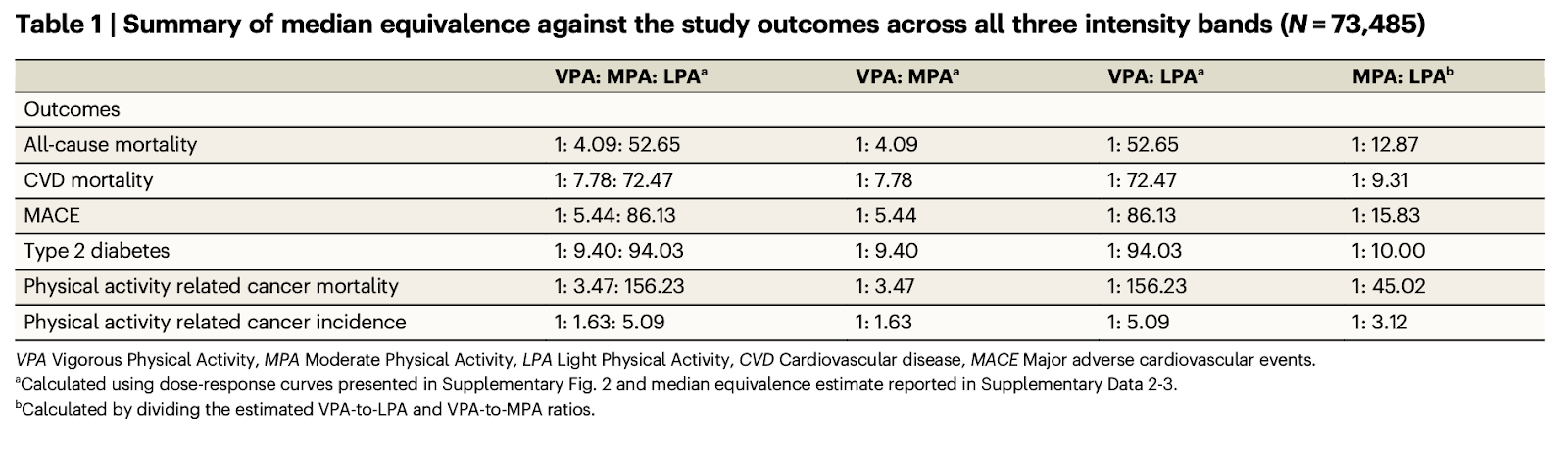
Let's take a moment to let this sink in. One minute of VPA (vigorous physical activity) is equivalent to 52 minutes of LPA (light physical activity) in decreasing all-cause mortality, 72 minutes for heart disease deaths, 86 minutes for heart attacks, and 94 minutes for diabetes development. These relationships are frankly astounding.
This stands to completely reshape how we prescribe fitness regimens to both treat and prevent chronic disease. Playing these numbers out, 10 minutes of VPA is worth over 15 hours of LPA at decreasing your risk for developing diabetes.
A key concept to understand is the importance of increased blood pressure (and thereby blood flow) from high-intensity exercise. The sheer stress created by this increased flow improves the health of the lining of our arteries. It is also an effective way to kill cancer cells. Because their walls are weak, increasing blood pressure exerts forces on them they cannot withstand, causing them to rupture and die as opposed to spreading and setting up shop in new tissue.
Dr. Rhonda Patrick recently did a two-hour podcast on this paper with her colleague Brady Holmer. In it, she highlights that this is why she does CrossFit, as it allows her to get all of the most important aspects of exercise in the most efficient and effective way possible.
McCoy Medical is a lifestyle concepts-based practice. Understanding the importance of intensity in your fitness regimen is paramount to both healthspan and lifespan. In fact, it may be the most important part. If you are local, join us at our affiliate in Chagrin Falls. If you need help building intensity into your routine, let us know and we can make it happen.
Pate, R. R., Pratt, M., Blair, S. N., Haskell, W. L., Macera, C. A., Bouchard, C., Buchner, D., Ettinger, W., Heath, G. W., King, A. C., & et al. (1995). Physical activity and public health. A recommendation from the Centers for Disease Control and Prevention and the American College of Sports Medicine. JAMA, 273(5), 402–407. https://doi.org/10.1001/jama.273.5.402
Bull, F. C., Al-Ansari, A., Biddle, S., Borodulin, K., Buman, M. P., Cardon, G., Carty, C., Chaput, J. P., Ekelund, U., Fishman, E., Foucaud, J., Grobler, L., Heath, G. W., Hupin, D., Janssen, I., Katzmarzyk, P. T., Lambert, E. V., Leitzmann, M., Li, J., ... Willumsen, J. F. (2020). World Health Organization 2020 guidelines on physical activity and sedentary behaviour. British Journal of Sports Medicine, 54(24), 1451–1462.
Biswas, R. K., Ahmadi, M. N., Bauman, A., Biddle, S., Blair, S. N., Bull, F., Burton, J. A., Chodzko-Zajko, W., Ekelund, U., Fishman, E., Foucaud, J., Grobler, L., Heath, G. W., Hupin, D., Janssen, I., Katzmarzyk, P. T., Lambert, E. V., Li, J., ... Willumsen, J. F. (2025). Publisher Correction: Wearable device-based health equivalence of different physical activity intensities against mortality, cardiometabolic disease, and cancer. Nature Communications, 16(1), Article 9581. https://doi.org/10.1038/s41467-025-65754-4